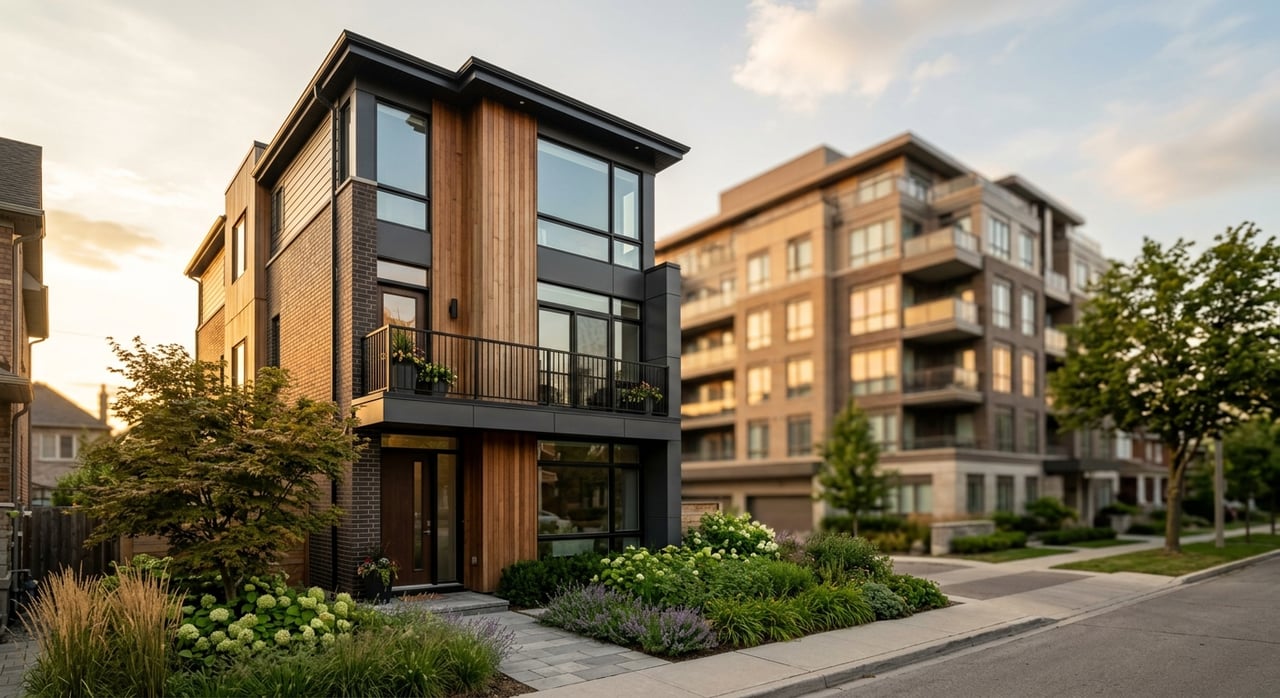
Mississauga Condo vs Townhome: Choosing Your First Home
May 14, 2026
May 14, 2026
Buying your first home in Mississauga can feel like choosing between two very different lifestyles. You may love the lower entry price and convenience of a condo, but also want the extra space and independence a townhome can offer. The good news is that the right choice usually becomes clearer once you look at budget, maintenance, ownership structure, and daily routine. Let’s dive in.
One of the biggest first-time buyer mistakes is assuming that “condo” means apartment and “townhome” means freehold. In Ontario, that is not always true. A condo is an ownership structure, and it can include apartment units, stacked townhouses, rowhouses, and townhouse complexes.
That means a townhome in Mississauga could be either condominium titled or freehold. If it is a condo townhome, you own the unit and share ownership of common elements through the condominium corporation. If it is a freehold townhome, you typically own the land and structure and take on more direct responsibility for the property.
This distinction matters because two homes can look similar from the outside but come with very different monthly costs, rules, and maintenance expectations. Before you fall in love with a layout, make sure you understand the title and how the property is owned.
If budget is your first filter, current Mississauga pricing gives you a useful starting point. According to TRREB’s April 2026 market watch, the median price was $490,500 for condo apartments, $725,000 for condo townhouses, and $850,000 for attached or row townhouses.
That creates a meaningful gap for first-time buyers. The median condo townhouse was about $234,500 more than the median condo apartment, while the median attached or row townhouse was about $359,500 more than the condo apartment median. For many buyers, that difference can shape not only what you buy, but when you buy.
Here is a simple snapshot of those benchmarks:
| Home type | Median price in Mississauga |
|---|---|
| Condo apartment | $490,500 |
| Condo townhouse | $725,000 |
| Attached or row townhouse | $850,000 |
These figures do not tell the whole story, but they do help frame the decision. In general, condos tend to offer a lower entry point, while townhomes usually require a larger upfront budget.
A lot of first-time buyers see condo fees and immediately think, “That is money I would rather not pay.” That reaction is understandable, but it helps to look at what those fees are designed to cover.
In Ontario, condo fees may include costs tied to common property such as snow removal, landscaping, cleaning, utilities, insurance, security, property management, and contributions to the reserve fund. Reserve funds are mandatory, and they are meant to help cover major future repairs and replacements.
So while condo fees add a monthly expense, they also bundle services and long-term planning into your ownership costs. If you prefer predictability and less hands-on upkeep, that can be a real advantage.
For many first-time buyers, the condo versus townhome choice is really a maintenance choice. Do you want more of your monthly costs packaged into a fee, or do you want more direct control and responsibility?
In a condo setting, the corporation is generally responsible for common elements and standard-unit items. Owners are generally responsible for decorative features or non-standard upgrades. In practical terms, this often means a condo owner handles less exterior maintenance directly.
With a freehold townhome, you are usually more responsible for the structure and exterior upkeep. That can mean more freedom, but it can also mean more planning for repairs, seasonal maintenance, and unexpected costs. If you like the idea of managing your own property, that may suit you well. If you want a simpler ownership routine, a condo may feel more comfortable.
Control matters just as much as cost. A condo can offer convenience, but it also comes with governing documents and community rules that shape how the property is used.
For example, condo rules can regulate things like pets, smoking, noise, parking, and short-term rentals. If you think you may want to rent out the property in the future, that is especially important to review early. Ontario’s Condo Authority says owners can rent out their units, but landlords must notify the corporation and provide a copy of the lease within 10 days.
A freehold townhome may give you more day-to-day control over the property, depending on the specific title and setup. That said, more control often comes with more direct responsibility. The best fit depends on what matters more to you: simplicity or independence.
In Mississauga, your commute and daily routine can make one option much more attractive than the other. If you want a car-light lifestyle, a condo in a transit-connected area may be worth a close look.
Mississauga’s Official Plan 2051 defines Major Transit Station Areas as roughly 500 to 800 metre walking areas around transit stations. The city identifies 54 stations within Mississauga along current transit corridors, including Hurontario and GO rail lines.
The Hazel McCallion Line will add another important layer of connectivity. Metrolinx says the line will run 18 kilometres with 19 stops from Port Credit to Brampton Gateway, with connections to MiWay, Brampton Transit, Züm, and GO links at Cooksville and Port Credit.
For first-time buyers, that makes transit-oriented condos near City Centre, Cooksville, and Port Credit especially compelling if your goal is easier commuting and less dependence on a car. If your routine involves downtown access, regional transit, or a more urban setup, condo living near these hubs may offer strong day-to-day value.
A condo may be the better first home in Mississauga if you are looking for:
This option often suits buyers who want to get into the market sooner and keep day-to-day upkeep more manageable. It can also be a smart fit if your schedule is busy and convenience matters.
A townhome may be the better fit if you are looking for:
This can be appealing if you are thinking longer term and want a home that gives you more physical space and independence. Just be sure the added responsibility matches your comfort level.
If you are buying a resale condo or condo townhome, the status certificate is one of the most important documents in the process. It is the main due-diligence document because it includes the condo corporation’s governing documents, reserve fund information, common expenses, special assessments, insurance details, and litigation information.
The Condo Authority of Ontario says the corporation can charge up to $100 for the status certificate and must provide it within 10 days. For a first-time buyer, this document can reveal whether a property is financially stable and whether there are issues that may affect your ownership costs or comfort.
In other words, the decision is not just condo versus townhome. It is also which condo, which townhome, and under what ownership structure.
If you are still torn, these questions can bring clarity:
Your first home does not need to be your forever home. It needs to be a smart fit for your life right now, while also supporting your long-term goals.
In Mississauga, condos are often the more affordable and lower-maintenance starting point, while townhomes usually offer more space at a higher price and with more owner responsibility. Neither option is automatically better. The right choice comes down to how you want to live, what you want to spend, and how much ownership responsibility you want to take on.
A thoughtful first purchase starts with clarity. If you want strategic guidance on comparing condos, condo townhomes, and freehold townhomes in Mississauga, connect with Anna Fan for polished, informed advice tailored to your goals.
Continue exploring insights and updates from the blog.

Work with a knowledgeable advisor focused on design, innovation, and smart investment opportunities.